Gage Harrison loved the fog.
While other divers cursed the low visibility and the U.S. Coast Guard warnings, Gage saw it as a curtain being drawn, revealing secrets for a select audience. He was an artifact hunter, a polite term for a man who plundered forgotten wrecks. His small, cluttered dive shop on the Embarcadero was a museum of his sins: encrusted bottles, brass fittings, and a wall of illegally salvaged portholes.
His obsession, his white whale, was the Estrella Perdida. A Spanish galleon that, according to legend, went down in a storm off the Morro Bay headlands in 1709. Most historians said it was a myth. But one piece of the legend, the part Gage clung to, was specific. The ship had “anchored in the fog” just outside the harbor mouth, and the anchor, a four-ton behemoth, was still there, holding the ghost of the ship to the seabed.
The legend had a hook: the anchor could only be found when the “fog kisses the seafloor.”
For years, Gage had dismissed it as folklore. But for the last few months, a new, strange kind of fog had been plaguing the bay. A thick, static-charged, metallic-tasting fog that didn’t just obscure the world, it erased it. And on those nights, the bay, usually a chaotic symphony of sea lions, went completely and terrifyingly silent.
Tonight, that fog was back.
It had swallowed the Rock by 9 PM. By 10 PM, the Embarcadero was a ghost town. Gage stood at the end of his pier, breathing in the air that tasted like a wet nine-volt battery. He couldn’t see the sea lion dock, but he didn’t need to. He could feel its emptiness. The silence was a heavy, pressing weight.
The only sound was the two-tone groan of the breakwater horn, a lonely, desperate pulse in the void.
Brummmm-Hoooooo.
“When the fog kisses the seafloor,” Gage whispered to himself, a manic grin spreading across his face.
This was it.
While every other mariner in their right mind was tying off extra lines, Gage was rolling a 50/50 Nitrox mix into his twin tanks. He ignored the “Hazardous Bar” warning light flashing from the Coast Guard station. He zipped up his heavy-duty drysuit, cinching the seals around his neck and wrists.
He cast off the lines to his 24-foot rigid-hulled inflatable, the Relic. The boat’s twin 150-horsepower engines were too loud for the dead-silent harbor. He kept them at a low, throaty idle, slipping past the dark, slumbering trawlers like a shadow.
He navigated by the glowing green-and-purple chartplotter. The harbor mouth was a place of legendary violence, where the outgoing tide collided with the ocean swell, creating standing waves and currents that could drag a boat onto the rocks in seconds.
Tonight, there was no swell.
As he cleared the end of the south jetty, the water, which should have been a chaotic chop, was flat. Unnaturally flat. Like a sheet of obsidian. The Relic glided over it, the only disturbance in a dead world.
Brummmm-Hoooooo.
The foghorn was behind him now. Ahead, there was nothing.
He cut the engines at the coordinates he’d spent a decade refining. The GPS showed him hovering directly over the channel’s deepest point. His high-end sonar, however, was useless. The screen was a wash of “snow.” The fog, he realized, was so dense with static or some unknown particulate that it was scrambling the signal.
“Doesn’t matter,” he muttered, checking the seals on his GoPro. “I’ll be able to see it.”
He cinched his dive helmet, the integrated comms hissing with static. He clipped his high-intensity cannister light to his harness and locked his dive knife in its sheath on his calf. He felt like an astronaut, preparing to step onto another world.
He stood on the gunwale, looked down into the black, oily water, and rolled backward.
The shock of the water was instant, but it wasn’t the 55-degree cold he was used to. It was colder. Impossibly colder. It was a dry, searing cold that felt more like a chemical burn. His drysuit, rated for arctic conditions, felt as thin as paper.
He activated his helmet-mounted light and began his descent, pulling himself down the anchor line of the Relic.
The first thirty feet were typical “low-vis” Morro Bay. Murky, green, and full of particulate. He could barely see the end of his fins.
Then, at forty feet, he punched through a layer.
It was like descending from a cloudy sky into the cloud itself. The water changed. It was no longer green-black. It became a thick, opalescent, milky white.
The fog.
The fog didn’t stop at the water’s surface. It continued down. It was a pillar, a column of cold, white, spectral mist, plunging from the surface into the abyss.
“My God,” he breathed, his voice a metallic rasp in his helmet. The sound was deadened, as if the fog were swallowing his words.
The water temperature gauge on his wrist computer was no longer giving a number. It just read: ERROR.
The cold was in his bones, a deep, penetrating ache that made his joints stiffen. He fought the sudden, primal urge to abort, to claw his way back to the surface. The greed was stronger.
He kept descending, deeper into the milky void. His light was useless, the beam hitting the white fog and scattering instantly, illuminating nothing but the cloud around him. He was falling blind, guided only by the rope in his hand.
At 110 feet, his fins touched silt. He was on the bottom.
He knelt in the ooze, his visibility less than six inches. He was breathing too fast, his heart hammering. He was about to give up, to admit defeat, when his helmet-light grazed something dark.
It wasn’t the silt. It was solid.
He crawled toward it, his gloved hands sinking into the cold mud. The dark shape grew. It was metal. It was corroded.
He put his hand on it and felt the unmistakable shape of a fluke. An anchor fluke.
“Yes… yes!” he hissed.
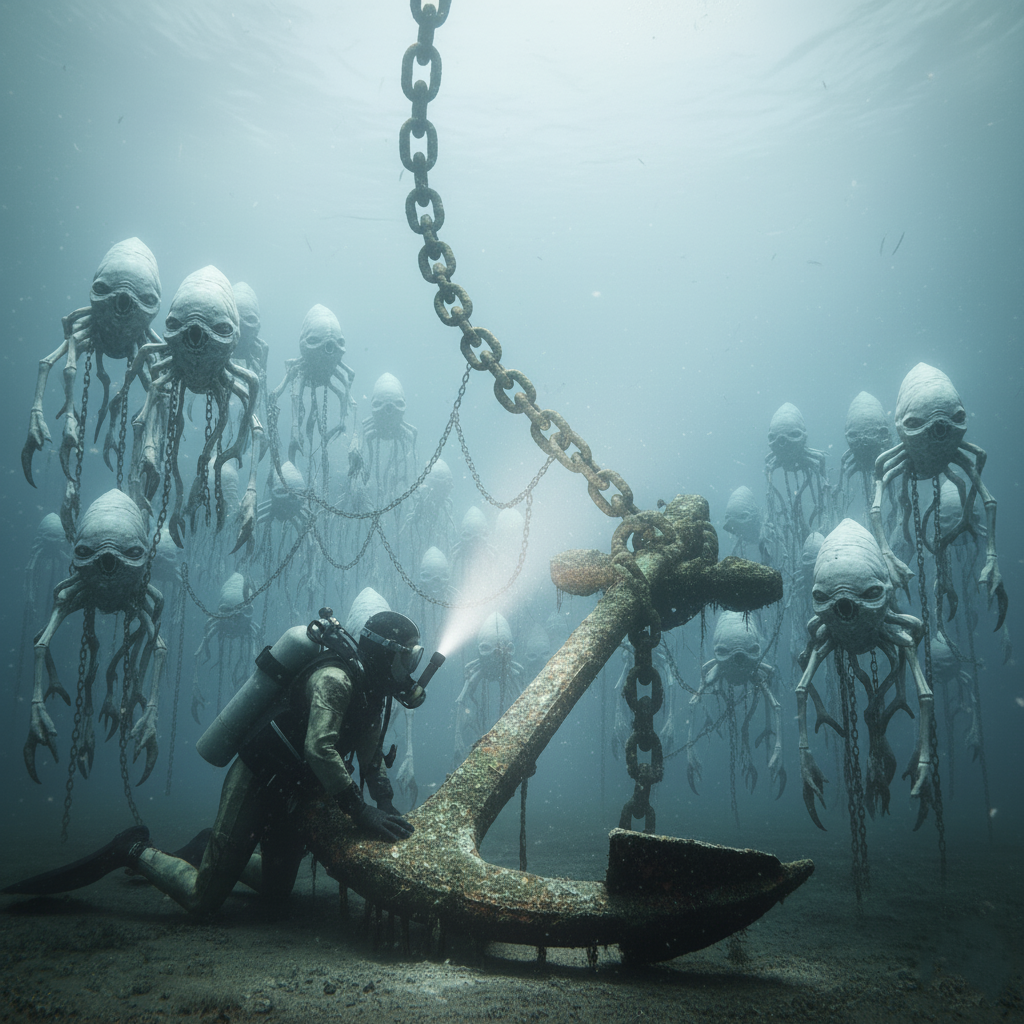
He’d found it. He ran his light over it. It was colossal. The shank was as thick as his body, the flukes taller than he was. It was covered in a century of corrosion, but it was unmistakably a Spanish-era anchor. He had done it. He was rich. He was a legend.
He unclipped his GoPro, filming his gloved hand as he touched the pitted iron. He panned the light up the massive shank, which rose into the milky fog above him.
“Got to see the chain,” he mumbled, his voice giddy. “Got to see the chain.”
He followed the anchor up to the ring, where the chain should be. And he saw it. A massive, iron-bar chain, with links as long as his arm, stretched taut across the seabed, disappearing into the white gloom.
But the anchor wasn’t holding a ship.
Gage panned his light, following the chain, and his heart stopped.
The chain was a trunk. And branching off it, like the limbs of a great tree, were hundreds of smaller, black, glistening chains.
At the end of each smaller chain was a thing.
He was in a forest. But it wasn’t kelp.
All around him, drifting in the unnatural current of the fog-pillar, were pale, dormant bodies. They were tethered. Anchored.
He saw the Takers.
They were exactly as the other myths had described them. Pale, segmented, slug-like bodies. Long, multi-jointed, chitinous limbs that drifted lazily in the cold, like the fronds of dead kelp. They were all sizes. Some were small, the size of a man. Others were as big as a car, their limbs thirty feet long.
They were all here. A silent, sleeping army, anchored to the seafloor.
“This is…” he couldn’t form the words.
He wasn’t in a treasure trove. He was in a prison. A cage.
This was the “fog that kisses the seafloor.” It wasn’t a time; it was a place. A pillar of pure, cold energy that kept these things dormant. The anchor wasn’t a relic; it was a lock.
He backed away, his fins kicking up clouds of silt. He bumped hard into the main anchor chain.
He looked at it. The link where the anchor met the main chain was almost gone. The centuries of corrosion, accelerated by the unnatural cold, had eaten it away. It was a thread of rust, a fragile, crystallized piece of iron, groaning under the immense, collective strain of the dormant horrors it held.
It was going to break. Soon.
Gage’s mind raced. He had to get out. He had to warn… someone.
But the artifact hunter in him, the greedy, obsessive part, screamed one last, fatal command.
Evidence.
No one would believe him. He needed proof. A piece of the chain. Just a chip.
He drew his dive knife. He also unclipped the small geology hammer from his harness.
“Just one piece,” he whispered, his breath clouding his visor.
He swam to the fragile, decaying link. He could see it fracturing under the tension. He raised the hammer, his light fixed on the spot. He wasn’t going to break it. He was just going to tap it. Just knock off a piece of the rust-eaten surface.
He tapped the link.
There was no sound. Just a dull thud that he felt in his arm.
The link did not chip. It shattered.
It exploded in a silent, crystalline puff of black rust.
The tension on the great chain was gone. The massive iron links clattered to the seabed, burying themselves in the silt. The anchor was free. The prison was open.
Gage froze, the hammer still in his hand. He watched, paralyzed, as the massive main chain began to rise. Without the weight of the anchor holding it down, the natural buoyancy of the creatures and the unnatural pull of the fog above was taking over.
For a full second, the forest of pale “kelp” just drifted upward in the cold.
Then, the drifting stopped.
Every pale, segmented limb, all at once, stiffened.
The silence in his helmet was broken by a sound. It wasn’t coming from the water. It was in his head. A dry, chittering, insectile click that multiplied, amplified, becoming a psychic scream of a thousand voices, all waking at once.
CLICK-CLICK-CHITTER-CLICK
Gage dropped the hammer and looked up, his light cutting a frantic beam through the milky water.
The entire forest of Takers was moving. The dormant bodies were contracting, pulling themselves upright. They were awake. And they were rising.
Gage scrambled for his ascent line, kicking frantically for the surface, for the living, breathing air. But he stopped.
The creatures weren’t looking at him.
In the 360-degree, opalescent white void, a thousand pale, featureless heads turned, as one, toward the surface. Toward the faint, diffuse glow of the harbor lights filtering down from above.
They ignored the small, frantic man in the diving suit. He was nothing to them. He was just the key.
Gage watched as the first of the massive, car-sized Takers flexed its limbs and propelled itself upward with a powerful, silent stroke. Then another. Then a hundred more.
A dark, swarming cloud of monsters ascended past him, their blue bioluminescence pulsing in time with a new, terrifying hunger. They were rising from the deep. They were rising toward the boats, the docks, the sleeping town.
Gage hung there in the empty water, his breath fogging his visor, watching the army he had just unleashed disappear into the white ceiling above.
And then, from the darkness below, where the anchor still lay in the mud, a single, small Taker drifted up. It didn’t follow the others. It drifted toward Gage.
It wrapped a cold, segmented limb around his ankle. It wasn’t an attack. It was an embrace.
You… the voice whispered in his head, sounding like the groan of a dying ship. You… are… the… new… lock.
Gage screamed, a sound swallowed instantly by the water, as the Taker pulled him down into the silt, down to the heavy iron ring, down to take his place in the dark.
Above him, the surface of Morro Bay began to boil.
By Pamela Beach ‘Beyond the Blog’
The fog holds more secrets…
“The Sunken Anchor” is just one piece of the legend. Discover the other terrifying tales of the Watchers, the Takers, and the mist that consumes, in the full Morro Bay Fog-Mythos Collection.
And if you want the origin story, the exclusive tale that started it all, and the upcoming stories as I write them, be sure to subscribe to my newsletter. I’ll send “Where the Fog Settles First” straight to your inbox as a thank-you gift.
Pamela Beach is a multi-genre author, poet, and lyricist who writes from her home on California’s foggy Central Coast. She is the creator of the “Morro Bay fog-mythos” and author of The Unstoppable You. You can read more of her work and explore her complete “fog-mythos” collection at her blog, Beyond the Blog with Pamela Beach
Curiosity powers this blog, but coffee powers the blogger. Enjoy the content? Consider buying a cup to help fuel the next deep dive. Your support makes all the difference! https://beyondtheblog.org/power-the-next-post/
Leave a Reply