A Morro Bay Fog-Mythos Story
Poppy Briar didn’t just sell wind chimes; she curated symphonies for the wind.
Her shop, “The Whispering Glass,” was a landmark on the Embarcadero. Tourists and locals alike came to stand inside, enveloped in a gentle, chaotic orchestra. Thousands of chimes, crafted by her own hands, hung from the ceiling: triangles of soft green sea-glass that tinkled like rain, hollowed bamboo tubes that offered deep, resonant thrums, and spirals of capiz shells that rattled like a snake’s warning.
Poppy was a creature of sound. She lived in the small apartment above the shop, and the chimes were her lullaby, her alarm clock, and her shield. They were a bright, harmonious defense against the one sound she truly hated: the oppressive, two-tone groan of the breakwater foghorn.
Brummmm-Hoooooo.
It was a sound, she felt, that didn’t warn. It threatened.
She loathed it. And she loathed the fog that brought it.
She woke one Tuesday to a silence that pressed down on her like a physical weight. The world was gone. Not just visually, but audibly. The sea lions on the floating dock, normally a barking, chaotic metropolis, were dead quiet. Her own chimes, which hung from the eaves of her porch, were mute.
She looked out her apartment window. The “wrong” fog had come in.
It wasn’t the high, wispy fog of a normal morning. This was the “bruise-fog,” a low, churning, charcoal-grey mass that tasted of ozone and old pennies. It didn’t just obscure the Rock; it devoured it. It pressed against the glass, not like weather, but like a living thing seeking entry.
Poppy sighed, the metallic taste of the air coating her tongue. “No business today, then.”
She went downstairs, her bare feet cold on the wooden floor. She unbolted the shop’s front door to flip the “Closed” sign out, a signal to the few brave (or foolish) souls who might be walking the mist-shrouded boardwalk.
She opened the door, and the cold hit her. It was a chemical, biting cold that had nothing to do with the temperature.
And she saw it.
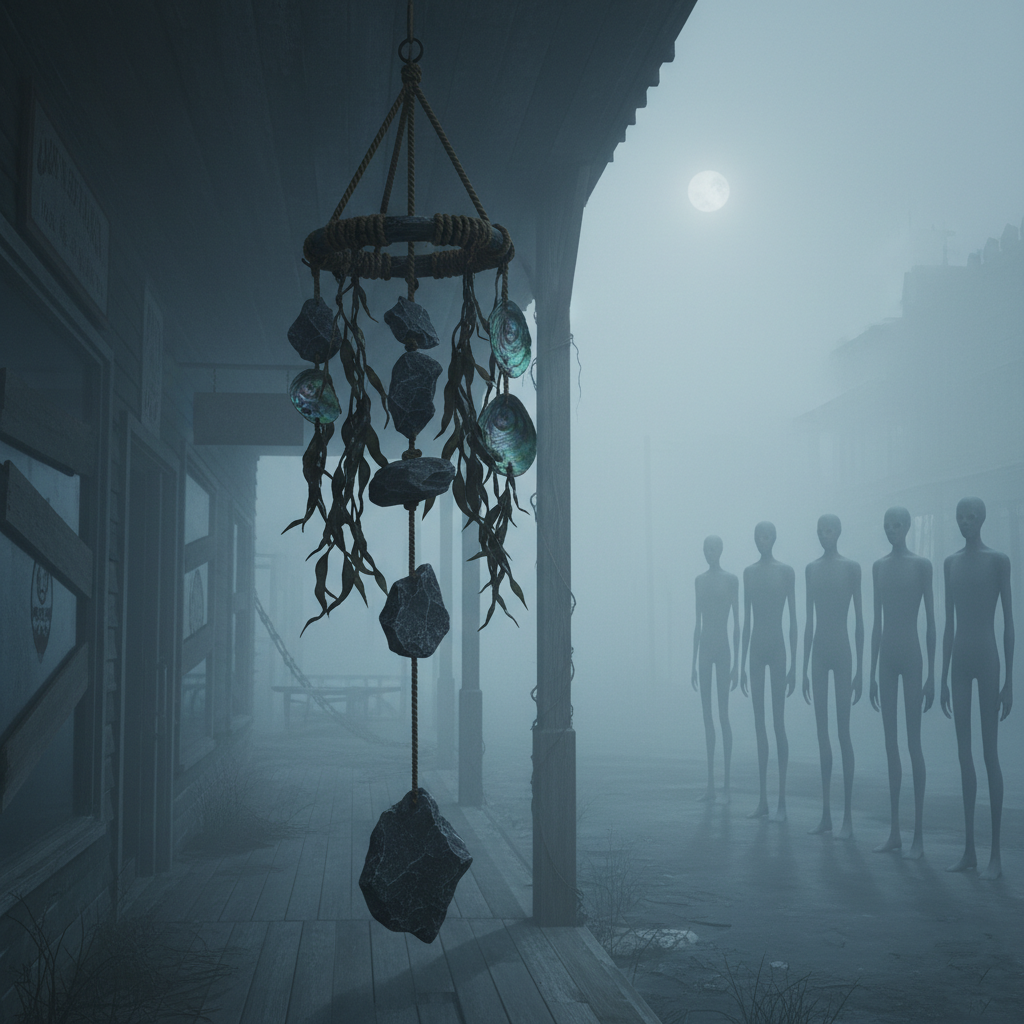
It was hanging from the central, strongest hook on her porch, a hook she reserved for her largest, most complex “cathedral” chimes.
It was a chime she had not made.
It was grotesque.
Where her work was light and airy, this was heavy and dense. It was not strung with fishing line, but with something that looked like dried, black, twisted kelp. The chimes themselves were not glass or shell. They were fragments of something… oily. Dark, pitted, volcanic-looking stones that seemed to drink the light. And interspersed between them were shards of abalone.
But it wasn’t the beautiful, iridescent mother-of-pearl. It was the outside of the shell, the rough, pocked, and calcified husk. They were strung in a way that seemed deliberately chaotic, designed to clash and grate.
Poppy stared, her artisan’s soul repulsed. “Who put this… junk… on my hook?”
A gust of wind, cold and damp, funneled down the Embarcadero. It was a strong, steady breeze.
Her own chimes on the porch, the sea-glass spirals, and the capiz shells sprang to life, their tinkling, rattling sounds a sudden, desperate spray of notes against the oppressive silence.
The new chime… swung.
It moved as a single, heavy unit. The black stones and abalone husks swung wildly, close enough to impact. They should have made a sound. A clack. A scrape. A dull, heavy thud.
They made nothing.
The pieces swung, they grazed, they collided… and there was no sound. It was as if the chime were a black hole for acoustics. It was actively eating the sound.
Poppy felt a wave of vertigo. Her ears, so finely tuned, were screaming at the visual-auditory lie she was witnessing.
She reached out a trembling hand to touch it.
“Don’t be a fool, Poppy,” she muttered. She went back inside and grabbed a pair of thick, leather work gloves.
She returned to the porch. She grabbed one of the oily, black stones.
The cold was instantaneous. It punched through the glove, a freezer-burn so intense it made her gasp. It was the cold of the deep ocean, the cold of a tomb.
She let go, ripping her hand back.
Brummmm-Hoooooo.
The foghorn groaned, and the sound seemed to warp as it passed the chime, the note bending and souring.
“It has to come down.”
She grabbed the kelp-like string at the top. It was stiff, hard as iron. She tugged. It didn’t budge. It was fused to the heavy iron hook, as if welded there.
“What in God’s name…?”
She went inside, grabbing a pair of heavy-duty wire cutters. She put her full weight into the tool, clamping the jaws on the black “kelp.”
The cutters made a dull snap. The metal jaws broke. The kelp was uncut, unmarred.
A deep, primal fear began to uncoil in Poppy’s stomach. This was not a prank. This was not art.
This was an anchor.
She backed into her shop, her eyes fixed on the soundless, swinging thing. She slammed the door, locked the deadbolt, and pulled the heavy curtain over the door’s glass window.
But she couldn’t block out the silence.
The chime’s effect was spreading. The air in her shop was heavy, dead. She looked up at the ceiling. The thousands of chimes, her life’s work, were hanging perfectly, unnaturally still. The small drafts that always made them sing were gone. The air was thick, gelatinous, and silent.
The shop was freezing.
She went to the main display window, the one that looked out onto the boardwalk and the street. She peeked through the blinds.
The fog was a solid, churning wall of grey. The world was gone.
No. Not entirely.
There was movement. Across the street, standing in a loose, silent line at the edge of the seawall, were figures.
At first, she thought they were tourists, huddled in the cold. But they were too still. And too… wrong.
They were tall, thin, and the color of the fog itself. Their limbs were too long. They wore no coats. They were just… standing. Facing the water.
“The Watchers,” Poppy whispered, her blood turning to slush. She had heard the stories. The fog-mythos. The tales of the Dark Watchers in the hills, the Takers in the tide pools. She’d dismissed them as campfire stories, creative writing from the local author.
Brummmm-Hoooooo.
The foghorn sounded and the figures turned.
As one, their featureless, grey, wet heads swiveled. They weren’t looking at the water anymore. They were looking at her shop. They were looking at the chime.
Poppy fell backward, scrambling away from the window. “No. No, no, no.”
They weren’t Watchers. They were Takers. The ones from the sea. And they were ashore.
She understood. The chime wasn’t just silent. It was a summons. It was a lighthouse, a beacon for them. A signal, in a frequency she couldn’t hear but could feel, that told them: This spot is safe. Come ashore. Anchor here.
She spent the day in the back of her shop, in her small office, under a single, buzzing fluorescent light. She drank tea and tried to pretend the world wasn’t ending
As dusk fell, the fog, as it sometimes did, receded. She crept to the window. The street was empty. The Takers were gone.
The chime was still there.
The silence in her shop was a living, breathing entity, and she was suffocating in it.
“I will not be driven out,” she said, her voice a small, trembling thing. “This is my home.”
That night, she brought a mattress down from her apartment, deciding to sleep in the “safety” of her office. But sleep was impossible. The silence was louder than any noise.
At 2 AM, she woke up. Not to a sound. But to a change. The cold was gone. The air in the shop was… warm. And the silence was broken.
She heard… tinkling. Her chimes. They were singing. A soft, gentle, chaotic melody, just as they always had.
Poppy sat up. “The fog… it must have lifted.”
She walked out of her office into the main showroom. It was pitch black.
The chimes were singing. A beautiful, random, gentle song.
Tinkle. Rattle. Thrum.
“Thank God,” she breathed, a sob of relief in her throat.
She walked to the front door, to look outside, to see the stars.
She put her hand on the curtain over the door’s window.
Tinkle. Thrum. Clack.
The sound was beautiful. But… wait.
The foghorn.
Brummmm-Hoooooo.
It was still going. The fog hadn’t lifted.
Poppy’s hand froze, inches from the curtain.
If the fog was still there… what was making the chimes sing? There was no breeze. The door was locked. The windows were sealed.
Thrum. Tinkle. Tinkle.
The sound was coming from the center of the room.
Her hand, shaking so violently she could barely control it, found the main light. She turned it on, and the shop was flooded with light.
And she screamed.
They were inside.
Dozens of them. The Takers. They hadn’t been waiting across the street. They had been waiting for her to sleep.
They were moving through her shop, their tall, grey, glistening forms brushing against the thousands of chimes. They were the “wind.”
They were “playing” them.
They all stopped when the light came on. Their featureless heads turned to her. In the hollows where their eyes should be, a thousand tiny, cold, blue lights swirled like captured galaxies.
They were admiring her work. They were admiring the sounds.
One of them, standing directly in front of her, tilted its head. It was holding a single, beautiful, blue-glass chime from her “Ocean” collection.
It raised its other hand, a long, wet, grey appendage, and pointed.
It was pointing at the front door.
It was pointing at the soundless chime.
A voice slid into Poppy’s head. It was not a sound; it was a feeling, a vibration that rattled her teeth. It was the sound of the foghorn, of the sea, of scraping stone, and of a billion whispering voices.
“It… is… beautiful…” it said, in a chorus that made her knees buckle. “We… heard… the… call. The… silent… song”.
“Get out,” Poppy whispered, tears streaming down her face. “Get out!”
The Taker tilted its head again. “But… it… is… incomplete.”
It took a step toward her. “You… make… the… sound. We… bring… the… silence. We… will… make… a… new… song. Together.”
The Taker was at the door. It reached through the solid wood, its arm dissolving into grey mist and reappearing on the porch outside. It grabbed the soundless chime.
It pulled its arm back through the door, the wood groaning and splintering as the chime, the anchor, was brought inside.
The fog roared.
The windows of the shop bowed inward. The fog, no longer held at bay by the anchor outside, now surged in, pouring under the door, through the cracks, through the walls themselves.
The Takers stood in the center of the room, a silent, grey audience.
The soundless chime, now in the center of her shop, began to swing.
And Poppy watched, in frozen, abject terror, as the fog congealed, not around the chime, but around her.
The Taker holding her blue-glass chime stepped forward. “The… anchor… is… set,” the voice whispered in her head. “Now… the… offering.”
It held out the chime to her, as if asking her to play.
“Show… us… the… sound… of… your… soul.”
Poppy couldn’t move. She was paralyzed, a statue in her own museum. She watched, in abject terror, as the fog congealed, not around the chime, but around her.
The Takers gathered closer, a silent, grey audience.
The one in front of her, the one holding her blue chime, reached out its other hand. It didn’t grab her. It just gently, almost curiously, touched the side of her throat, its freezing, vaporous fingers resting on her larynx.
Poppy opened her mouth to scream, but no sound came out.
The creature had taken it.
She felt a vibration. The monster’s hollow, featureless face tilted, as if listening to something only it could hear. It was “hearing” her scream, her terror, her soul.
It nodded, a slow, dreadful gesture of satisfaction.
“It… is… beautiful.”
The Takers turned, as one, and began to drift back out, passing through the walls like smoke, their purpose fulfilled. The fog receded with them, pulled back into the night.
The heavy, soundless chime remained, now hanging from the central beam of her shop.
Poppy was left alone in the wreckage. She was alive. She was unharmed.
She ran to the door, her hands shaking so hard she could barely unbolt it. She burst out onto the boardwalk. The air was clear. The sea lions were barking. The world was blessedly, beautifully loud.
She cried, great, heaving sobs of relief, leaning against the doorframe.
A tourist, a young man with a camera, saw her. “Ma’am? Are you okay?”
Poppy nodded, wiping her eyes. “Yes,” she tried to say. “I’m… I’m fine.”
But no sound came. Her mouth moved, she gasped for air, but the only thing that escaped was a dry, hollow puff of wind.
The young man frowned, confused.
Poppy’s hands flew to her throat. She tried to scream. She tried to cough. She tried to make any sound at all
Nothing.
She was a creature of sound. And they had taken her voice.
Two Weeks Later
The “Going Out of Business” sign hung crooked in the window of “The Whispering Glass.” The shop was empty, the thousands of chimes already sold or given away.
A real estate agent was showing the property to a new couple.
“It’s a wonderful location,” the agent said, her voice echoing in the now-silent room. “The last owner, a lovely woman named Poppy, retired. Left in a hurry.”
“It’s so… quiet in here,” the wife said, looking up at the empty ceiling hooks. “You’d think with the wind off the bay, you’d hear… something.
“It’s good insulation!” the agent chirped.
The husband, meanwhile, was looking at the single, strange object that remained. It was a dark, heavy chime made of pitted stones and abalone husks, hanging from the central beam.
“They forgot this one,” he said, reaching up to touch it.
“Oh, don’t,” the agent said. “The owner was very specific. That’s the only thing that stays. She said it was an ‘anchor’.
The husband reached up and flicked one of the black stones with his finger. It swung, colliding with a piece of abalone.
The shop was filled with a single, pure, beautiful note. A high-pitched, crystalline Heeee.
The husband smiled. “Well, what do you know. It does work.”
Outside, miles away, the fog on the horizon, which had been in retreat, suddenly stopped. It paused, it tasted the air, and then, slowly, it began to turn back toward the shore.
It had heard the call.
By Pamela Beach
The fog holds more secrets…
“The Soundless Chime” is just one piece of the legend. Discover the other terrifying tales of the Watchers, the Takers, and the mist that consumes, in the full Morro Bay Fog-Mythos Collection.
The best way to know when the next story emerges from the mist is to subscribe to my newsletter!
As a thank-you for joining, you’ll get a free download of my exclusive subscriber-only short story, “Where the Fog Settles First,”—a spooky tale you can’t read anywhere else.
Pamela Beach is a multi-genre author, poet, and lyricist who writes from her home on California’s foggy Central Coast. She is the creator of the “Morro Bay fog-mythos” and author of The Unstoppable You. You can read more of her work and explore her complete “fog-mythos” collection at her blog, Beyond the Blog with Pamela Beach
Curiosity powers this blog, but coffee powers the blogger. Enjoy the content? Consider buying a cup to help fuel the next deep dive. Your support makes all the difference! https://beyondtheblog.org/power-the-next-post/ or https://buymeacoffee.com/pambeach
Leave a Reply