Dr. Lily Lancaster lived her life by data, and the data was telling her a ghost story.
Her world was sound. From her cramped, gear-stuffed office at the end of a moldering pier, she studied the acoustic chaos of Morro Bay. Her specialty was the complex, layered language of the Zalophus californianus—the California sea lion.
And in Morro Bay, language was a riot.
The floating dock, moored just a few hundred yards from the T-pier, was the town’s noisiest, smelliest, most beloved landmark. It was a chaotic, blubbery metropolis of over a thousand pounds of barking, grunting, groaning, and belching life. Lily’s hydrophones, sunk in the channel beneath them, captured a 24/7 wall of sound. It was the vital, reassuring heartbeat of the harbor.
Until a specific kind of fog rolled in.
She had first noted the anomaly three months ago, during a dense autumn mist. She was cataloging recordings when she hit a section of audio that was completely wrong.
It wasn’t just quiet. It was empty.
The barking didn’t fade; it was guillotined. At 02:17 AM, the cacophony of a thousand animals was there. At 02:18 AM, there was nothing. Just the tidal wash, the distant, two-tone groan of the breakwater horn, and a faint, high-pitched static on the recording that made her headphones ache.
She had gone out to check, flashlight in hand. The fog was a solid, pressing wall that tasted like a wet nine-volt battery. She had reached the end of the pier, shining her beam where the massive floating dock should be.
It was gone.
Not sunk. Not drifted. Just… empty. As if every single sea lion had, in the span of sixty seconds, agreed to evacuate.
The next morning, the fog lifted, and they were all back. Barking, fighting for space, and acting as if nothing had happened.
Lily, a woman who believed in observable phenomena, logged it as an unexplained predator event. A pod of Orcas, perhaps, or a truly massive Great White, spooking them into the water.
But the data didn’t support it. There were no Orca vocalizations on the audio. And if a shark was the threat, why would they all flee into the water, where the shark was?
Then it happened again. A month later. Same fog, low, thick, and carrying that same metallic, ozonic smell. Same time: just after 2 AM. Same result: a sudden, terrifying silence, and an empty dock.
Now, it was November. The air was cold, and the specific, cursed fog had just swallowed Morro Rock.
Lily sat in her office, bathed in the green glow of her monitors. The audio feed from the hydrophone was live. The familiar, chaotic barking filled the small room. Outside, the world was gone.
Brummmm-Hoooooo.
The foghorn groaned, a sound that was usually a comfort but tonight felt like a warning.
At 01:47 AM, the barking changed.
The lazy, territorial grunts vanished. They were replaced by short, sharp, explosive barks. Agitated. Panicked. It was the sound of a thousand animals suddenly, simultaneously, staring at a gun.
“Come on, show me,” Lily whispered, her fingers flying over her keyboard, triggering a thermal camera feed from a unit she’d mounted on the pier, aimed at the dock.
The screen flickered, resolving into the ghostly white-hot shapes of the sea lions. They were no longer resting. They were a writhing, terrified mass, all oriented in one direction: facing the deep shipping channel.
“What are you looking at?”
Then, her headphones hissed. The high-pitched static from her previous recordings screamed to life. It wasn’t static. It was a sound. A dry, clicking, chittering rattle, like a billion insects, just at the edge of human hearing.
And beneath it, from the hydrophone, a new sound bloomed. A low, powerful, percussive pulse.
THUD… THUD… THUD…
It was not a boat engine. It was not a whale. It was slow, rhythmic, and impossibly heavy. It was the sound of something colossal, walking on the seafloor.
On the thermal camera, the sea lions broke.
It was a waterfall of panic. The entire mass of animals, bulls, cows, and pups, poured off the floating dock and into the water. But they weren’t swimming out to sea.
Lily watched her laptop, her blood turning to ice. A secondary tracker, this one on the beach of the sandspit, showed a wave of bodies hauling out of the water, scrambling up the dunes with desperate speed. Another group was heading in her direction, toward the harbor.
They were hiding. They were fleeing the water, fleeing the channel, and hiding on land.
The pulsing THUD… THUD… in her headphones stopped.
And the chittering, insectile rattle moved. It was no longer coming from the hydrophone. It was coming from the air.
It was coming from outside her office.
Lily ripped the headphones off, her ears ringing. The silence of the room was overwhelming. The barking was gone. The world was dead, save for the foghorn.
Brummmm-Hoooooo
She looked at her primary monitor. The thermal camera was still pointed at the floating dock. The dock was empty, bobbing in the black water.
No. Not empty.
Something was crawling onto it.
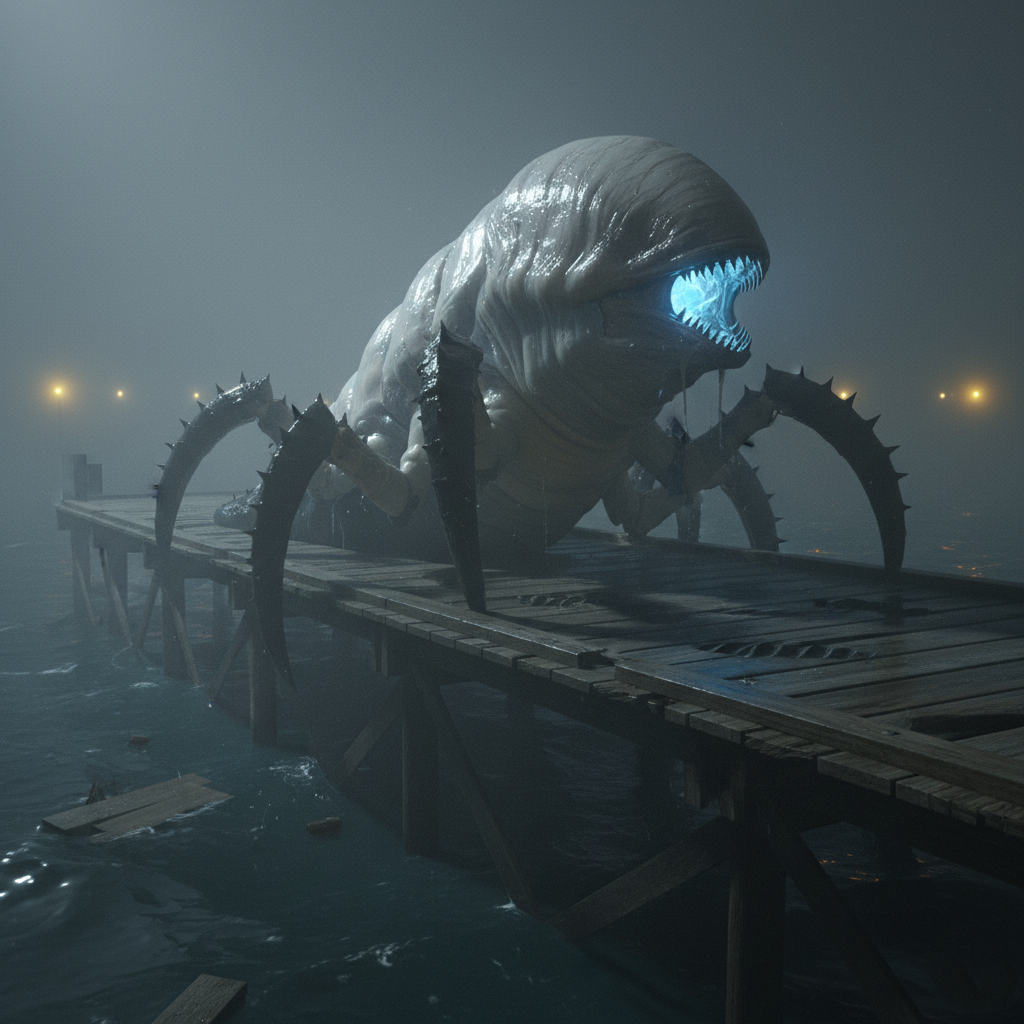
It was cold. The thermal camera, which registered heat, showed it as a void, a shape of pure black, colder than the water. It was enormous, easily twenty feet long. It hauled its glistening, dark mass out of the channel and onto the dock, which sank dangerously under the weight.
It wasn’t a shark. It had… limbs. Too many limbs. They moved with a wet, spider-like articulation, pulling its slug-like, pale body forward.
Lily watched, her breath caught in her throat, as the thing sniffed the air. It raised its “head”, a featureless, glistening cone, and seemed to test the wind. It was hunting. It had missed its prey.
It turned, its cold, black shape swiveling on the camera. It was looking directly at the pier.
Directly at her.
A rational, scientific part of her brain calmly assessed the situation: The creature was on the floating dock, a hundred yards away. She was safe in her office.
A wet, percussive SLAP-DRAG echoed from the wooden planks just outside her door.
It wasn’t on the floating dock.
There was more than one.
Lily didn’t scream. She didn’t move. She just stared at the plywood door of her office, which was the only thing separating her from the sound.
SLAP-DRAG… SLAP-DRAG…
It was moving past her office, heading toward the shore. Hunting the sea lions that had fled onto the Embarcadero.
She had to see. It wasn’t bravery; it was a furious, scientific compulsion. She was a biologist. This was the discovery of a lifetime, or the end of one. She had to see it.
She killed the lights in her office, plunging the room into the grey, soupy glow of the fog. She grabbed her night-vision monocular, a heavy, military-grade piece of equipment, and slowly, silently, cracked the door.
The cold was immediate. It was a freezer-burn cold that stung her eyes and lungs. The air was thick with the smell of low tide, kelp, and something else. A sharp, coppery scent that smelled like old pennies and fresh blood.
She pointed the monocular into the fog. The world turned a sickly, phosphorous green.
She saw it.
It was thirty feet away, its back to her. It was a nightmare of biology. It looked like a crustacean and a cephalopod had been hideously combined. Its body was a pale, segmented, gelatinous mass that glistened with sea-slick. Six multi-jointed, chitinous limbs, as thick as telephone poles, propelled it, their sharp ends digging into the wood of the pier.
It was dragging the bloody carcass of a sea lion pup in a massive, beak-like maw that pulsed with a faint, blue bioluminescence.
As she watched, the creature paused. It clicked. The insect-rattle sound vibrated in her chest.
From the fog ahead, an answering click returned.
From the rocks by the shore, another click.
From the roof of the harbormaster’s office, another click.
They were coordinating. They were hunting in a pack.
Lily lowered the monocular, her hands shaking so violently she almost dropped it. The fog was not a cloak for the monster. The fog was the monster, or at least, the hunting ground it brought with it. The sea lions knew. They knew that when the air tasted like metal and the fog settled, the Takers, the things she had read about in the local mythos, the things she had dismissed as folklore, came ashore.
She began to back slowly into her office. Her foot hit the metal door-jam with a soft clink.
The creature in front of her stopped.
The dragging sound ceased. The blue light in its maw extinguished.
For a second, there was only the foghorn, a lonely, mechanical heartbeat
Brummmm-Hoooooo.
The creature moved.
It didn’t turn. Its whole body spun on its central axis with impossible speed. Its six legs slammed into the pier, and it charged.
Lily screamed and threw herself backward, slamming the door and fumbling for the deadbolt. The impact shook the entire building. The sound was not a body hitting wood; it was a car hitting wood. The door bowed inward, the frame splintering
CLICK-CLICK-CHITTER-CLICK!
The sound was deafening, coming from just outside, an alien rage.
Another impact. The deadbolt held, but the wood around the lock was visibly cracking.
Lily scrambled back, grabbing the heaviest thing she could find, a crate of batteries and hydrophone parts. She shoved it against the door.
The creature slammed into it a third time. The top hinge ripped free from the wall. The door fell inward, held only by the bottom hinge and the battery crate.
A pale, chitinous, spear-like leg punched through the splintered plywood. It was glistening, black, and sharp as obsidian. It retracted, then stabbed again, shredding the door.
Lily looked around, her mind racing. The window.
It was small, high, and faced the water.
She climbed onto her desk, her hands finding the latch. She shoved the window open and looked down.
The black, oily water of the harbor was fifteen feet below. It was her only escape.
The creature let out a sound that wasn’t a roar, but a harmonic scream, a layering of clicks and that high-pitched static that shattered the glass of her remaining monitors, and the door disintegrated. The thing filled the doorway, a mass of pale flesh and clicking, armored legs, its beak opening and closing, the blue light inside pulsing with hunger.
Lily didn’t hesitate. She jumped.
She hit the water. The cold was a physical blow, a shock that drove the air from her lungs. It was colder than any water had a right to be.
She surfaced, gasping, treading water in the blackness. She was under the pier. Above her, she could hear the creature demolishing her office, the sound of heavy equipment being thrown against the walls.
She was safe. She was in the water.
She began to swim, striking out for the pilings of the adjacent restaurant, for the shore, for land.
The foghorn groaned. Brummmm-Hoooooo.
She swam twenty feet when her hand hit something solid in the dark.
It was slick, vertical, and cold. She thought it was a piling.
She pushed off it, and the “piling” moved.
A low, resonant THUD vibrated through the water, rattling her bones. The sound she had heard on the hydrophone. The sound of the thing walking.
She looked down.
The flashlight she had dropped from her desk, the one that had rolled through the splintered door and fallen, was sinking slowly beneath her, its beam cutting a cone of light into the abyss.
The light illuminated the true, terrible silence of the sea lions.
The water wasn’t empty. It was full.
She was swimming in a forest of them. Colossal, pale, segmented legs, dozens of them, planted on the seafloor. They were the size of ancient redwoods. She was just a piece of flotsam in the canopy of their hunting ground.
The things on the docks, she realized with a gasp that filled her mouth with saltwater, were just the small ones. The scouts.
A shadow detached itself from the forest below. A shape of impossible size, colder and darker than the water, ascending directly toward her, drawn by the splash, by the movement, by the sudden, frantic beat of her heart.
By Pamela Beach ‘Beyond the Blog’
The fog holds more secrets…
“The Silent Sea Lions” is just one piece of the legend. Discover the other terrifying tales of the Watchers, the Takers, and the mist that consumes, in the full Morro Bay Fog-Mythos Collection.
The best way to know when the next story emerges from the mist is to subscribe to my newsletter!
As a thank-you for joining, you’ll get a free download of my exclusive subscriber-only short story, “Where the Fog Settles First,”—a spooky tale you can’t read anywhere else.
Pamela Beach is a multi-genre author, poet, and lyricist who writes from her home on California’s foggy Central Coast. She is the creator of the “Morro Bay fog-mythos” and author of The Unstoppable You. You can read more of her work and explore her complete “fog-mythos” collection at her blog, Beyond the Blog with Pamela Beach
Curiosity powers this blog, but coffee powers the blogger. Enjoy the content? Consider buying a cup to help fuel the next deep dive. Your support makes all the difference! https://beyondtheblog.org/power-the-next-post/
Leave a Reply